Saturday, 2 July 2016

"A SAILOR ON A RAINPOOL SEA"

(R L Stevenson)

Chios is a beautiful island. Nobody will argue it; buildings, landscape and people. This is where we started our 2016 adventure and of course, we read our travel guru, Matt Barrett’s, before going. I quote directly from Matt’s blog to maintain a little distance…

"Ahhh Chios..." a former soldier reminisced. "I had ten girlfriends there at the same time. We all did." It’s probably changed since then but the number of extraordinarily beautiful women walking the streets of Chios town at night was mind-boggling. If I was single and 10 years younger... (better make that 30 years younger), I imagine I would have a pretty nice time in Chios-town. Being there with my wife just made me feel old. Watching beautiful girls walking by dressed in their summer finest is just torturing myself. Still, is there anything more beautiful than a young woman dressed-to-kill out on the town on a Saturday night in Chios? Probably not.

Well, I thought, that’s a good start. Turns out that, through observation, I can confirm that he was right! (I'm too old to be taking photos of young girls so you will have to come and see them for yourselves!)


When we first arrive for our three months of sailing, we have to ‘commission’ the boat, which takes anything from 4 days to a week. You can see that the boatyard is not a place you would want to stay in! 


So, Sally found us a B & B called Spillia, which means fairies in Greek, where we could spend a few days prior to our departure with our friends Susie and Charles. We stayed in this magical place for five wonderful nights getting to know Kiriaki and Dimitri who restored and own Spillia.


The fairies, in this case, are brought to life in a charming video that Kiriaki and Dimitri have created using some of the girls that Matt and I have observed. http://www.spilia-chios.gr

Dimitri and Kiriaki are amateur historians and take the heritage that abounds in their town of Ano Kardhamyla high on the slopes of the mountain above the port of Marmaro very seriously indeed. Dimitri is deeply involved in the restoration of windmills and in the recording of ancient sites that are known to only a few people. His passion is restoration, which is something that he and I have in common and that replaces a common spoken language. We exchanged books and discussed our interests through Kiriaki whose English is excellent. I learned that the reason for the keel shaped roof is to accommodate the huge wooden crown wheel placed in a vertical plane above the small pinion. The arrangement requires massive power but is capable of spinning a mill stone of enormous weight very fast. 


It is Dimitri’s dream to create a museum for all the old artifacts that he has collected.


10 years ago, Spillia was a ruin. Crumbling walls and vaults that had caved in were all that remained of the little houses that were occupied perhaps 100 years ago. Using local skills, labour and materials, Dimitri and Kiriaki have rebuilt the structures to be the same as they were hundreds of years ago. I have photographed vaults under construction to show how it was done and to demonstrate that the ancient skills are still to be found. 


Each house that makes up the Spillia complex has been made into an en suite unit with kitchenette. It is thermally as well as spatially comfortable; tightly planned but cosy with outdoor areas for eating, reading and contemplating ones navel. We do a lot of all three!


The antithesis of Spillia is the boatyard in the bay of Tolos. We arrived to see seriously bad pollution surrounding our beloved boat; rusty pieces of boat, half sunken boats, plastic, polystyrene and wrecks of every description. Adonis is the king of one of the best examples of organised chaos that we have ever come across. I look forward to going back there next year, as, despite my initial misgivings, Adonis is a pleasure to deal with and did everything he was supposed to with enthusiasm and thoroughness.


Our boat is stored out of the water on the ‘hard’ every winter and getting 6.5 tons in and out of the water safely is not easy when you are using basic home made equipment. In sophisticated (and expensive) yards, a million Euro machine called a travel lift is used. Adonis uses a wheeled trailer that he moves using a 4 x 4 tractor along with some colourful Greek expletives and instructions to motivate his crew.


With the assistance of Susie and Charles, we cleaned and prepared Pegasus for the season and then prepared to launch. The launch was a somewhat awe-inspiring performance with feelings of horror, relief, disbelief and finally leading to laughter after Pegasus was plunged down the slipway to give her the momentum to clear another boat and come to rest, miraculously and safely, alongside a rusty old barge. 

We trust in Adonis; what else can we do?


Friday, 10 June 2016

WAR AND PEACE


A few weeks before Henry and I left for our 2016 sailing adventure, we received a very disturbing email from a new friend we had met while sailing last year. M works for the city of Paris, but because of her Greek connections has been seconded to the European Union, advising on the Greek economic crisis and, more latterly, the refugee crisis. She contacted us in a state of shock – she had just narrowly missed being caught in the bomb blasts in Brussels, which followed her horrifying experience last year when she was in the street outside the nightclub in Paris where the shootings took place after having just said goodbye to her friends who went inside. When she heard that Pegasus had spent the winter on the island of Chios and this was where we would soon be, she was appalled and cautioned us to immediately get the boat away from Chios and the islands adjacent to Turkey and sail away to the west. We are, she said “AT WAR……”


We had been following the refugee crisis avidly since encountering many people last year who had survived the crossing from Turkey to Greece and were on their way to start a new life in Europe somewhere. We sympathised with their plight, but as more and more refugees arrived, we also sympathised with the Greek islanders who were taking them in. We followed the news closely and decided that we would not over-react but get to Chios and see for ourselves what the situation was.

So, for the first time, we did not do a draft itinerary, but left SA with some trepidation two weeks ago for Greece and our first stop, Chios. We stepped off the overnight ferry at 04h45 in the morning and Costas was waiting for us with our rental car. While the sun rose, we sat with Costas drinking Greek coffee and eating spinach and feta pies and he was the first of many to tell us about the crisis and how the island is coping.


Chios has a bloody and embattled history, including the Turkish / Greek population swap in 1922 when the Turks on Chios were moved to Izmir in Turkey and Greeks in Izmir were moved to Chios. So, the people on Chios were also refugees once and they know what it is like to be displaced – even the young people remember the stories of their parents and grandparents and they empathise with the refugees. Over the last 18 months, they have welcomed the refugees, fed them and sheltered them. But now there are ripples of discontent. The Syrians, we are told, are quiet, well-mannered people who are grateful to be here. But there are groups from other countries, who are more demanding and aggressive and are, I quote, “causing trouble”.  Yesterday we visited the maritime museum in Chios Town and retired ship captain, Adonis, whose views were almost identical to those of Costas, told us about an attempt on Monday to burn down one of the camps. We sense frustration and anger building which is very worrying.

Retired ship-captain Adonis
Chios and its neighbour Lesvos, are very close to the coast of Turkey, about 8 miles away, and so these islands have received more refugees than anywhere else in Greece, making them so-called hotspots. There are 2500 refugees at the moment in Chios, staying in 3 camps, waiting, according to the recent agreement with Turkey, to be processed and either be given asylum or be sent back to Turkey. The largest camp is fenced off with barbed wire and people are not allowed to leave, but we understand that people move freely from the other 2 camps. We have not seen the closed camp or the second large camp outside town, and can only imagine what it must be like – people waiting to be “processed” – what an awful word!


The smallest camp is next to the main square in the centre of Chios town, and it seems peaceful. Each afternoon we have been in town, we have seen groups of children walking back from the school that has been set up for them. We have seen rows and rows of solitary men waiting outside the registration hall. We have seen families walking around town. We have seen British, Belgian, Italian and Greek military ships moored in harbour and patrolling the coast. We have seen many NGO staff – religious, medical, educational. But what we have not seen are tourists. Absolutely no holiday makers are here – delightful for us, but devastating for the people on Chios.


Pegasus alone in the harbour at Vasillos
Sharing the harbour with a naval ship
But the Greeks are a resilient bunch, and the stories we hear always include something encouraging and upbeat. They are pleased that the NGO’s are spending money on their island; they are proud of their unspoilt, verdant island, one of the most beautiful we have visited; they seem unfazed by the military presence - who are visible but recessive and, to us at least, at times quite friendly; they continue to greet us warmly and engage us in conversation; they are as generous as so many of the Greeks we have met on other islands and we are getting fat on the free desserts we are served after every meal. 

Delicious hot Loukamades dripping in honey - kind of like donuts but much better


So, Pegasus might be the only boat in the harbour, but we are glad we are here and we look forward to a wonderfully happy few months supporting the islanders in our small way by just being here – and by telling them how much we love their country. And maybe a few people who read our blog will decide to come and enjoy Greece and the Greeks as well.

Alone in the harbour at Lithi


Friday, 24 July 2015

OXI / NO / NEIN and THE ROAD DICTATES


We sailed from Rhodes to Symi on the day of the historical OXI / NAI referendum. We had been “stranded” in Rhodes for 2 weeks waiting for the boat to be fixed, and as usual we had made friends and spoken to many people.  Our hearts had gone out to the Greeks in the week run up to the referendum. Every person we spoke to was agonising over the vote but, without exception it seemed, they had all decided to vote OXI – NO! They could see that this could make life very tough, but at least they would be a little bit more in control and regain some dignity. We attended an OXI demonstration and got caught up in the emotion. It felt a bit like a pressure cooker going off – people were being asked what they thought and they were going to have their say by voting OXI. There was an amazing vibe with the sounds of passionate Rebetika protest songs wafting from all corners of Rhodes town. Debate was raging – the media was preaching irreversible doom and gloom if the vote was OXI, but we were not convinced. It was becoming more and more evident that big money – EU, IMF, big business – was influencing the media, and the ordinary people we were meeting were telling us a different story. 
We loved this Alpha bank which had become a donkey station in Lindos, Rhodes
Early in our Rhodes stay, we had met a wonderful young architect, Giannis Maroullakis, quite by chance. During our time there, he and his partners had befriended us and introduced us to Anastasia Papaioannou, an accomplished architect and heritage activist who had taken us on an amazing tour of the Italian architecture of Rhodes (remember Henry’s post – The Orphans of Fascism? Now he will have to write an update!) 
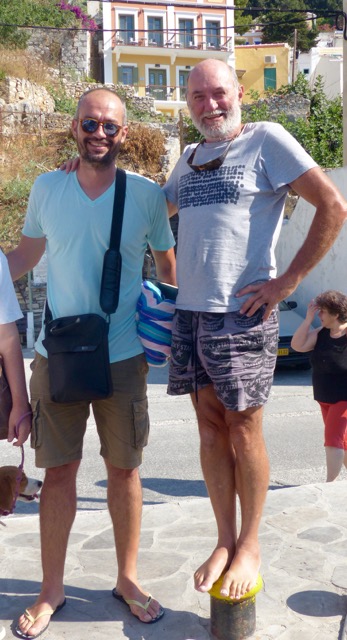
Giannis is a basket ball player and Henry had to stand on a bollard for the picture
The building where we met Giannis

Anastasia on the tour


The night before the vote, Anastasia invited us to her apartment for ouzo and mezze.  During our feast, her daughter phoned from Athens. She was at the 300 000 strong OXI demonstration in Syntagma square. Tsipras had walked from home and through the crowds – with no security. The atmosphere was electric and she was totally overcome with emotion.  Anastasia turned on the TV so we could watch – nothing. She changed channels – still nothing, only talking head studio discussions with the same old argument. Greeks had to tow the EU / IMF line and accept more and more drastic austerity, which so clearly was destroying Greece.  For the next few hours she checked regularly, still nothing. The private TV stations were refusing to cover this incredibly newsworthy, powerful demonstration.


Our friend Giannis sailed with us to Symi the next day after he had cast his early morning vote. It was a marvellous day – warm with perfect winds on our beam and Pegasus sliding through the water at a steady 6 knots. We stopped for a swim in our beautiful Symi bay on the way and we could see that Giannis felt at peace. He told us that he had felt a sense of hopelessness after he had voted, but now he was feeling exhilarated. After 6 hours of sailing, we got to Symi harbour, he caught the ferry back home and we went in search of our good old friends Philemon and Mercurious. 


And there they were – no surprises - playing passionate Rebitika with a cardboard OXI sign between them. After hugs and kisses, we once again got transported by the moving music, the warm people, the raki and the delicious food. It was hard to tell whether the songs got more mournful when it was clear that OXI had won, because no-one was under any illusion that it was going to be easy. But OXI meant NO to the forced crippling austerity and Yes to more negotiating power, and if necessary, the Drachma. At 1am, Henry and I walked arm in arm back to the boat, clutching the cardboard OXI sign as a souvenir, feeling happy and sad at the same time.


But of course, the story does not end there and the fears of the Greeks have been realised with the latest bailout proposal which effectively proposes the same level of austerity Greek voters had rejected in the referendum. Alexis Tspipras told allies: "Each one of us shall be confronted with his stature and his history. Between a bad choice and a catastrophic choice, we are forced to opt for the first one."

Adam Taylor from the Washington post captures the it very well in his article,  "The slow sad spiral of Greece's OXI movement". 
https://www.washingtonpost.com/blogs/worldviews/wp/2015/07/16/the-slow-sad-spiral-of-greeces-oxi-movement/


THE ROAD DICTATES
Every year Henry and I make an itinerary of our route – and we never keep to it. Unless we have to be in a certain place at a certain time, we follow the wind rather than the plan. Well, this year we have not only been subject to the wind, but to the Turkish navy and a grumbling Pegasus with a broken forestay and furler, dud VHF radio and a burnt out starter motor leaving us stranded with no engine  The broken furler drum and forestay kept us in Rhodes for two weeks – the critical time in June when winds are still manageable to cross to the Cyclades. 
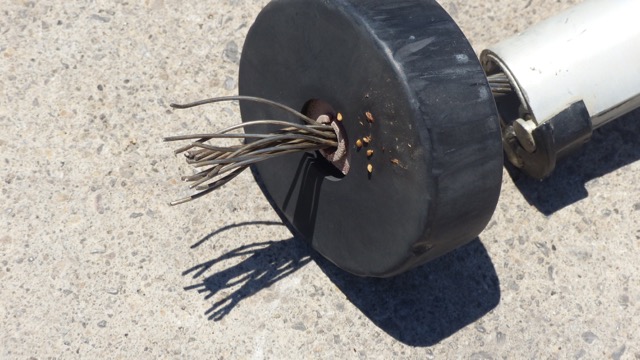
The broken forestay - it had been hanging on by a few wires when it broke
Fotis had to climb the mast 3 times with it being held up by rope - very dangerous
Hoisting the new forestay
But, nearly a month later (after leaving Rhodes we waited a few days for our friend Jon to get to us), we set off. This was with much trepidation, as the winds sweeping down this part of Aegean in July are enough to make the most hardened sailor quake with terror. And by now most of you will know that I am a windy weather wimp and when the wind gets up to more than 20 knots and we are bashing over waves, I go to pieces. So, when we received the sad news that our partner Ian’s father had had a stroke and they are having to delay their August 1st arrival by a few weeks, forcing us to turn back to find a safe place in the Dodacanese for Pegasus, I have to admit I felt a touch of relief. We both really wanted to go to old favourite and new unexplored islands in the Cyclades, but this comes at a windy price. So, we now find ourselves back on the Nyssiros, Tilos, Symi, Rhodes route. All islands by now much visited, but also much loved and all seem to welcome us back with open arms.

Alison's painting of our gorgeous Symi bay

Tilos police station from the boat


Kos town square
Henry and Jon in Kos
Kos
One of our favourite islands is Nyssiros, the active volcano island. It was Joe’s (Henry’s son) favourite and it also seduced Alison. This is what she wrote.


ALISON
Nissyros, aah Nissyros. What an island – basically I suppose just one big volcano. But filled with magic places and delightful discoveries. On arrival we hired a small car and on our first evening set off for sundowners along the coast. Sally and Henry had been to this little bar before but when Henry turned down a small unmarked track through what seemed like a building site I wondered where on earth we were going. The little road wound past dilapidated buildings (of which there are many in Greece) and over rubble and by now I was convinced we would find nothing down such an inauspicious track. But suddenly round a corner we spied a lone tiny table and two chairs next to the water’s edge and then to the right a building with steps leading up to an open door. “It is still here” cried Sally and Henry in unison and thus we arrived to experience the magic of Loutra.


It was like stepping into a film set, edgy and different and rather gothic. The small, protected patio looked down over the sea, the light lustrous and shimmering on the water as the day began to fade. The little beach below us was composed entirely of pumice stones from the volcano, in various shades of white and grey. To the other side a couple of fishing boats tied to the harbour wall bobbed gently.


The dramatis personae consisted – apart from the three of us feeling a bit like extras – of the young, lugubrious madame of the establishment and several friends sitting at a long table, two women chatting intimately, laughing and waving their cigarettes, legs akimbo and looking utterly relaxed and free. We were all struck by the sense of something different, as though we had stumbled onto the outer fringe of Greek society. We ordered wine and the inevitable delicious free mezze arrived. What a wonderful and generous Greek custom this is – you do not drink on an empty stomach and some or other small but delicious offering is usually brought to the table. And remember, this is a nation apparently going down the tubes.


The atmosphere at Loutra was electric and tantalizing and after our wine we sashayed off into the stillness of the night to feast on the boat. Since you ask - enormous and succulent pork chops which just snugged onto Henry's tiny and miraculous braai, mushrooms stuffed with feta and aubergine. 

Seduced by Loutra we went back the following night to enjoy more of this hauntingly beautiful place of dreams, but before that another action packed day exploring our volcano island. The actual volcano mouth is quite extraordinary, a lunar landscape of many plug holes gently steaming, bright yellow sulphur crystals sparkling at the edges, and not another soul in sight. In fact that was an important part of what I enjoyed about our explorations, being away from the great crush of tourism and consumerism, wandering off the beaten track, fossicking around, eating where the local Greek people eat, enjoying all the small marvels of this big-hearted country steeped in history and archetype. 


We found this chapel in a field in the caldera
Henry's sketch of the chapel
Nearby the little town of Nicolai straddles the hill tops. Like many Greek towns and villages it was built long before cars and the streets are narrow and winding and often consist only of steps. As we wandered up I marveled at the way the houses are jammed together, families living in such close proximity like a tapestry of life. Some of the little homes are old and crumbling, others freshly slicked up with splashes of that glorious Greek blue, each one individual yet part of the whole. 


At the top next to the church a tiny cafe and the only soul in sight the priest, bearded and black robed, drinking coffee and talking on his cell phone. This came to be a familiar sight and amused me greatly - near each church a little cafe where sits the black robed and bearded priest drinking his tiny expresso and chatting incessantly on his cell phone. A hot line to on high, I wondered! A refreshing bitter almond drink was served and we settled down to sketch, each absorbed in our own world.


The square at Nicolai - said to be the prettiest square in Europe


Hunger called, and we drove down from the volcanic heights to the little coastal town of Mandraki to search for a restaurant that Sally and Henry had visited before - chef and owner Davide produced a memorable lunch of freshly made pasta with a mushroom and cream sauce and a platter of seafood.  


Monastery in Mandraki

Then to explore another hill-side higgeldy-piggeldy mostly abandoned village, crumbling, fascinating, glimpses into lives past, other worlds and other times. And so the days are passing, images and impressions crowding my mind, evocative and memorable. And of course interspersed with all these adventures much talk of the Greek monetary crisis, the plight of the Syrian migrants as more arrive daily on various islands, the great archetypal themes of survival and migration.