Monday, 22 June 2015

Stress is not us........

One of the first things you notice about Turkish towns is the number of small businesses that seem to exist, if not, thrive.  There are, for example, more barbershops than one can believe could be viable; there are countless choices for men. In the importance given to grooming, and in so many other ways, Turkey and Greece are similar.


Surprisingly, as you may think, I regularly get a haircut and beard trim. Barbers are highly professional and a haircut is a luxurious moment of indulgence. On the day we left the town of Fethiye in Turkey I decided to get rid of the homeless person look and found a small shop in the back streets with no tourists, and agreed a price. As I sat down I realized that one of the barbers was having a kip, sprawled across a chair; his snores, unembarrassed, reverberated around the small room. I was empathetic; in a barber’ chair I always drift off a bit too…


As I sat there in my semi conscious state, despite the Edward Scissor Hands flash of snipping around my head, I was set to thinking about the region we have been traveling in for the past three weeks or so, images and thoughts chaotically filling my head.


Known still as Lycia this area was inhabited some 5 000 years ago when the foundations for an extraordinary civilization were born and recorded in cuneiform. Lycians have been important in power struggles in this part of the world since then and were part of the formation of present day Turkey. They were a powerful civilization that predated and rivaled that of the Greeks, Romans and Ottomans. They conquered and were conquered by, or made alliances with, every power that the Mediterranean has seen and thus left their mark on European culture. Their architecture can still be seen today. The Roman sarcophagus is derived from the Lycian and the pedimented Greek style of building is seen on their earliest tombs.


Sitting in my chair, my head being firmly adjusted at intervals, I saw in the people around me the heirs to those very Lycians with their influences of East and West that make Turkey so fascinating for us.


As a piece of sagging flesh was tugged aside to facilitate a better cutting angle, I reflected on the town of Kayakoi that we had visited a couple of days before.


Once occupied by both Greeks and Turks it is now a desolate collection of ruins as a result of the 1922 population swap between Turkey and Greece. 1.2 million Greeks and 400 thousand Turks. (It was reminiscent of the current exodus from Syria of a similar number of people). The vast majority of the inhabitants of Kayakoi, an important town at the time, were Greek and after their departure, the town was never occupied again.


The experience of walking around the deserted village is emotionally charged and sharpened by images of the Greek family whose house was now converted into a restaurant. The abandoned family photographs speak of the haste in which the family had departed. The hearths that families gathered around for generations, the paths and steps that were constructed by communal effort with stones worn smooth by thousands of feet remind me of what a dreadful wrench it must have been for these people to desert their homes, friends, sacred places; the accumulation of centuries of human collaboration. The tourist notice disingenuously claims that ‘… some people moved voluntarily but no violence or hurt was suffered.’


There are about three thousand houses clustered on the side of the steep hill yet every house retains its view. The materials of construction are universally stone and wood yet they each have a uniqueness that gives them individuality and the town its character. The stone remains but the timber lintels and roof beams have been pilfered. Each house is about 50 square metres. A multi cultural, egalitarian society, respectful of neighbours, reduced to ruin for dubious political reasons. It has always been so and it still is.


Without warning a flaming wad of cotton wool sweeps across my ears, singing the errant hairs! My God! No more dozing! No hair in my ears or nostrils escapes the man’s attention!
And then the wonderful shoulder massage that is part of every haircut. Mmm… here we go again!

And some more pics....

Ancient glass in the excellent Antalya museum

Details of Roman corinthian capitals and friezes from ancient Mira


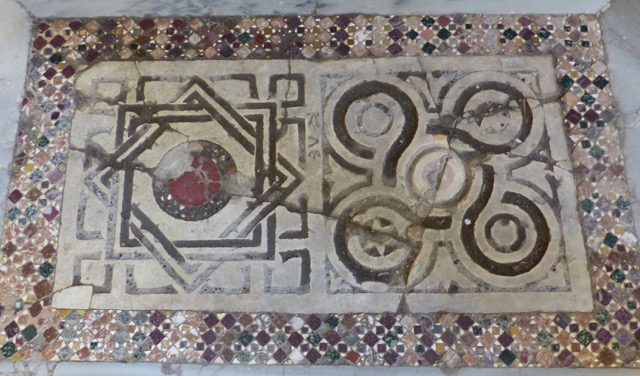
Mosaic floor of the Church of St Nicholas, Demra (Ancient Mira)

Rural Turkish house with clay tiled roof, originally clay in the same manner as our own "Brakdak"


Timber reinforcing to walls with stone detailing


Monday, 1 June 2015

A fez of the heart.

Apologies to Jeremy Seal for stealing his title.......

Nearly 3 weeks into our 2015 sailing, we have been accosted by the Turkish navy and sent back to port because of target practice (after setting sail in the early hours on a long passage with our VHF radio not working), survived a gale gusting at 60 knots (120km an hour) in a crowded harbour, been followed by 2 dolphins swimming in perfect unison and watched loggerhead turtles swim in crystal clear water…….


Gearing up to go sailing this year was even more challenging than usual. The building of House Botha and our new house on the cliffs at Ballots had been badly delayed and Henry was frantically drawing for both.  


We eventually left in a mad dash and arrived a few days later in Finike on the Turkish turquoise coast. A small, typically Turkish town with no tourism except for the few stray sailors from the small marina (this year with a travel lift, not an old fashioned sledge), we set to work cleaning and commissioning the boat for the summer.


Going about our business in the town was fun and satisfying. The food was cheap, the people were friendly and we watched intrigued as minibus after minibus, some much more luxurious than others, drove around the town blaring out what sounded to us like nursery rhyme jingles, followed by loud hailer exhortations enticing people to vote for them in the upcoming elections.


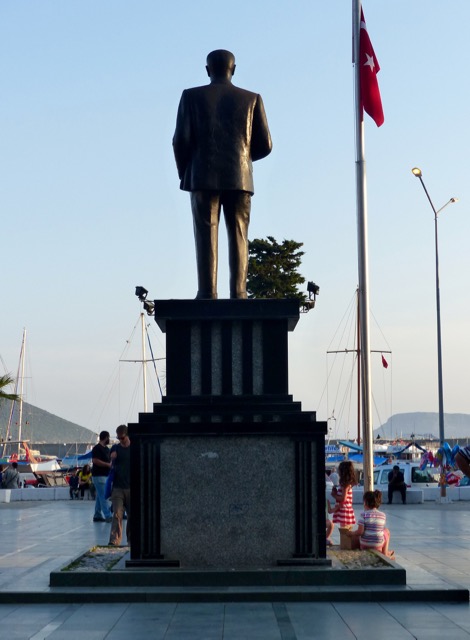
The political situation is Turkey is, as most know, very precarious at the moment. With Syria collapsing to Isis, everyone we have spoken to is anxious, some very frightened. In a part of the country where every shop, restaurant, home, square, public or private building, has a picture or statue of Kemal Attaturk, the people hang on jealously to the religious and cultural freedom Attaturk brought to Turkey in the 1930’s. Revered as Mandela is in South Africa, Attaturk is remembered for his banning of the burka and the fez, his recognition of women’s rights, his love of science and education and his ambition to make Turkey a secular country.


“I will lead my people by the hand along the road until their feet are sure and they know the way. Then they may choose for themselves and rule themselves. Then my work will be done.” Kemal Attaturk

“Freedom and Independence are my character” Kemal Attaturk

“My people are going to learn the principles of democracy the dictates of truth and the teachings of science. Superstition must go. Let them worship as they will, every man can follow his own conscience provided it does not interfere with sane reason or bid him act against the liberty of his fellow men.” Kemal Attaturk

“Teachers are the one and only people who save nations.” Kemal Attaturk

“Humankind is made up of two sexes, women and men. Is it possible for humankind to grow by the improvement of only one part while the other part is ignored? Is it possible that if half of a mass is tied to earth with chains that the other half can soar into skies?” Kemal Attaturk

 “Those who use religion for their own benefit are detestable. We are against such a situation and will not allow it. Those who use religion in such a manner have fooled our people; it is against just such people that we have fought and will continue to fight.” Kemal Attaturk


Of course there are always stories within stories, and as we learn more, we realize that Attaturk was a ruthless harbinger of change, and in his bid to stop the fez from being worn, he authorized the killing of hundreds of people. But this has not stopped most of the general population from loving him unconditionally, (except for our new friend Chalor, a young Turk who went to university abroad – “They are worshipping a fascist – but I can’t say that too loudly here or else people will lynch me…….”).


We don’t know what will happen in the election on June the 7th, but we do know that Turkey has been a surprise and a revelation for Henry and I. The scenery along the glorious coast is wild and spectacular – dramatic, rugged mountains encircling clear sparkling blue bays. The ruins of castles, ancient archaeological sites and old abandoned Greek villages lie scattered amongst the pine forests and thyme covered headlands.


But, as our highlight in Greece over the years has been our love of the people, so too here, the friendly, kind and welcoming Turks have seduced us.


A few days ago we hired a scooter in the charming but touristy town of Kalkan and rode over the rugged Tauras mountains to visit a village seldom visited by tourists we had read about, where the people of Kalkan live and work the land in the summer and then go back to the coastal town in the winter when it gets too cold. 

Using the mosque minaret to guide us to the centre of the village, we arrived outside a tiny shop and café – no village, a hamlet, a scattering of farmhouses. In what looked like an aggressive way, an old man gestured us to come and sit on a bench next to him outside the shop. Not a word of English, but when we said we wanted coffee, he hauled us with him a little way up the road to the café, followed by an entourage of old men, and bought us all coffee or chai. 


We set off to explore the old houses, built of stone and held together with a mud and straw mortar and roofed with soil. After a while, a women called us in to her house and offered us chai. Again, no English but incredible friendliness and hospitality. After drawing pictures of Pegasus and the map of Africa, her husband arrived home from the fields. Next thing she presented us with freshly made salad, gosleme (Turkish pancakes), olives, cheese and an omelet. When we got up to go, I gave her the beaded map of Africa brooch that I was wearing to say thank you, wishing we had more to give. Next thing she hurried off and came back with a scarf for me. Amazing warmth and generosity from people who are extremely 
poor.


But the kindness has not stopped there - yesterday we caught a dolmus (local mini bus) and went to Kayakoy, the Greek ghost town which inspired Louis de Bernier's "Birds without wings". In 1923, Greek families from the 3000 houses in the village were moved to Greece and Turkish families from Mesopotamia were moved to the village - they chose not to stay in the houses and the crumbling ruins are very moving and have an eerie energy. The chimneys particularly moved Henry and I - we think because they helped us imagine day to day family life.


While wondering around we got chatting to Ozman who was working on his newly purchased property that will soon be a beautiful pension. The surroundings were magical and captivated us - and next thing he had invited us to join him and his team to share in their very simple but delicious lunch. 


We have many more stories to tell, but for now, a few photos.........